
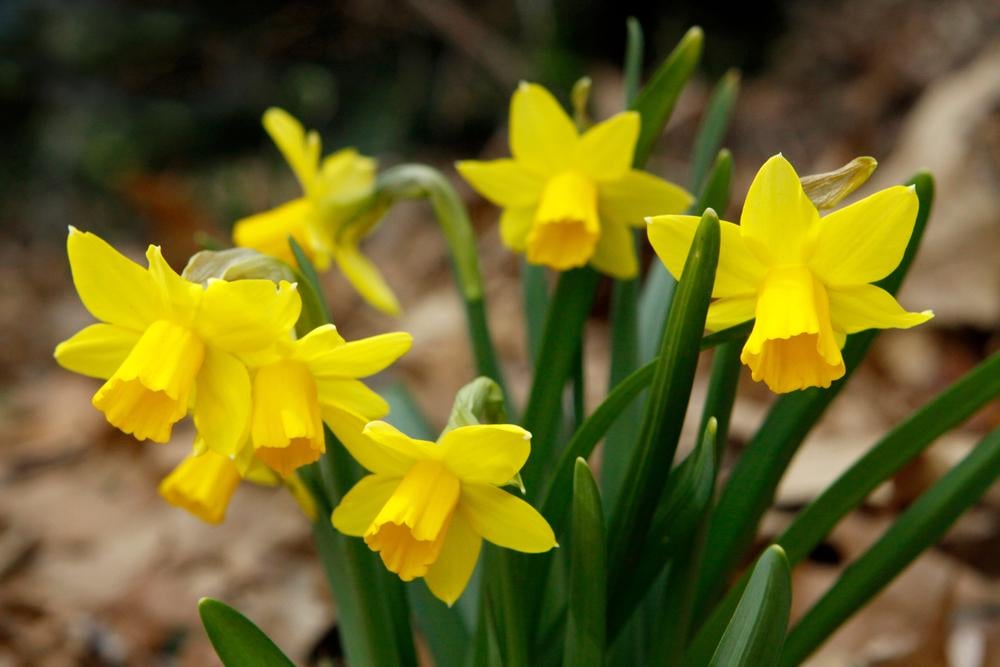
Wenn Sie jemals mitten im Wald ein Stück Narzissen blühen sehen, besteht eine gute Chance, dass Sie gerade die Überreste eines alten Wohngrundstücks gefunden haben. Die ersten Siedler brachten im 17. und 19. Jahrhundert Narzissen aus Europa mit und pflanzten sie als fröhliche Frühlingsmarkierungen um Hütten und Bauernhäuser herum. Lange nachdem das Haus verblasst ist und die Zäune gefallen sind, blühen diese Blumenzwiebeln weiter und erzählen leise die Geschichte dessen, wer einst dort lebte. Narzissen wurden geschätzt, weil Hirsche sie selten störten, sie sich leicht vermehrten und Hoffnung und Neuanfänge in einem rauen Leben an der Grenze symbolisierten.
Von: TN_Nursery
24 Comments
I used to be a field archaeologist and this is absolutely real. Random bulb plants in the woods generally means you’ve got a manmade feature nearby (often a house, accessory building, or a fence line).
I’m a forger and every time I see this it gets me excited because I’m also looking for anything else that may be nearby
also rhubarb patches which survive a long time.
I love baby daffodils 🧡🧡 they’re so small a fairy could sit on them
I love this! Yes, seeing them in the woods really gets my mind going. Once I went and dug up a couple.
Lilacs here in New England. Somewhere nearby there’s an old cellar hole
Or there’s just busy squirrels who stole them from a near by house. If a property is THAT old, you won’t just have one singular little patch of daffodils. They spread like wildfire. I lost count of how many are here (1880’s farm house).
🏵️DAFFODILS!🏵️
I live in a townhouse smackdab in the middle of American Civil War (mostly developed) battlefields, with one old house that is probably half a mile away, so I can only imagine that my yard was once part of their land. There are some random daffodil patches in the woods along the creek behind my house, so I’ve always imagined that they were planted in someone’s garden a couple hundred years ago.
If one were industrious, one might take a metal detector to this area and search for hidden trinkets and treasures.
I grew up in the Chicago area and our forest preserves swallowed up a lot of old homesteads. I’ve identified other plants in the Northeastern quarter of the country that are signs of where these old European settlements used to be, including but not limited to; Norway Spruce, Asparagus, Hyacinths, Tulips, Persian Lilac, German Iris, Scotts Pine, English Ivy, Winter Creeper, Apples, and Pears. If you see these there’s a good chance foundation remnants, rusted farming equipment, cellar holes, privy pits, or an old well could be nearby.
I have found daffodils (some with paper whites growing beside them) in the woods in a few places in my state. I always assumed their must have been a house there at some point
This is often true of lone apple trees also. They live on for a long time.
I’ve heard about that! That’s awesome!
Lily of the valley at our house! I found these deep in our woods and then about 20 feet away was a small foundation. Entire area is a multiflora rose paradise that we’ve been clearing.
The old honestead lives on. Wonderful.
🩷
My husband’s grandmother was born in 1885. Her little house was moved to town because the new road was coming through. Tulips still bloom there where her garden used to be.
Unless you live near my Mom who found out that daffodils can live just fine out in the woods and started planting them at random locations.
so special to see-good stories there! Little. House books!
My first one just bloomed in my yard, I don’t remember seeing them in past seasons since I’ve started my gardening journey, it bloomed and I was so excited!!! The previous owner planted so many wonderful surprises.
When we bought our house, we decided to build a raised bed in the sunniest spot for veggies. Soon we found broken glass, an old carburetor, a fishing pole, beer and soda tabs, broken ceramic, and a Harry S. Truman coin! I think it was someone’s burn pit. Needless to say, we decided to do food in containers (small, urban yard). Disappointing as hell. We’ve thought about getting a metal detector to find out what else is there (the soil is hard clay, so you can’t really dig without a pick axe-needs to be worth the massive exertion!) Still, with rains things float to the surface. I’m pretty sure the spot was used from the 40s to the 60s based on what we have found.
Beautiful 💐
i never seen sucha beautiful flower from where I live