
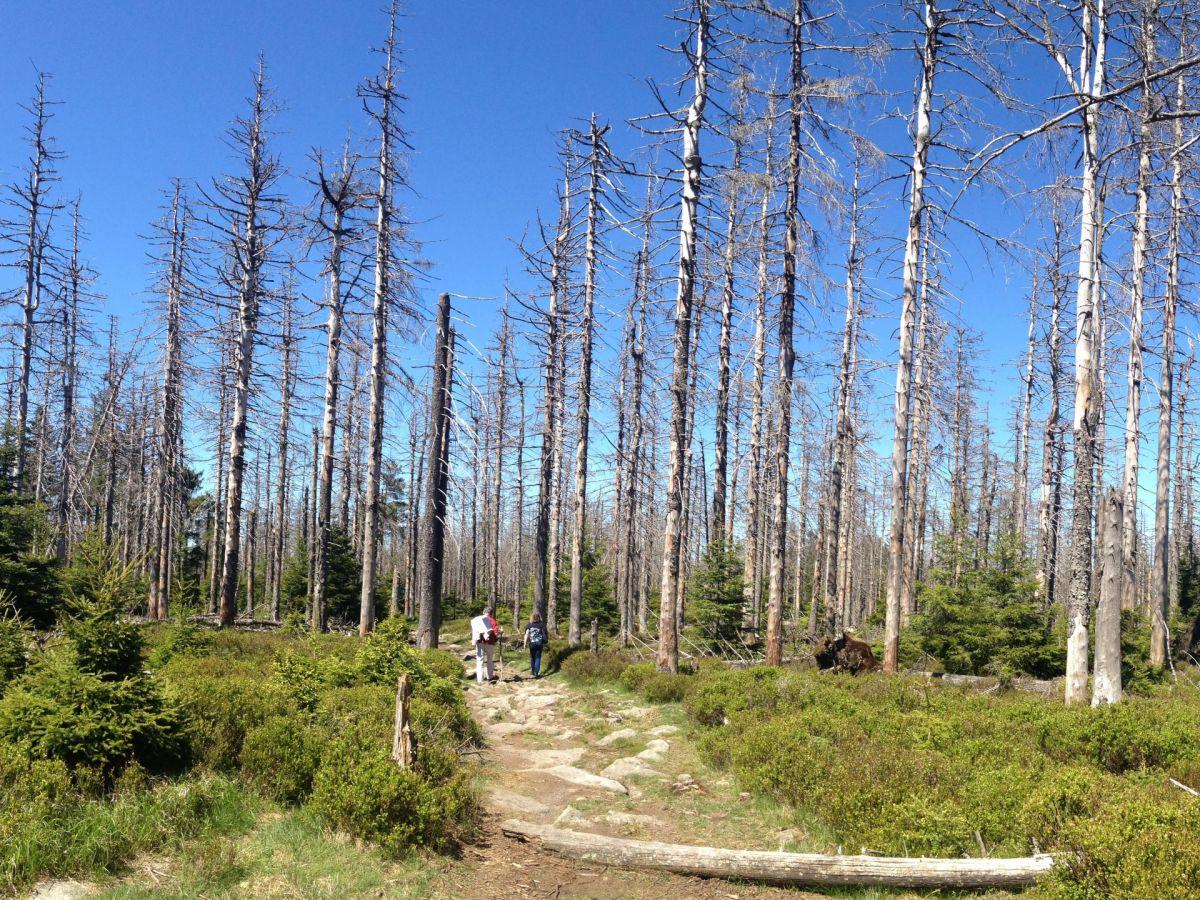
Wir haben diese Kiefern hier in Deutschland und viele von ihnen sind in letzter Zeit aufgrund der durch die globale Erwärmung verursachten Dürre und Borkäferschäden abgestorben.
Nun, das ist nicht verwunderlich, aber in anderen Teilen des Waldes mit toten (alten) Buchen usw. haben sie diese Bäume abgesägt.
Allerdings bleiben all diese abgestorbenen Kiefern stehen. Ich mache mir nicht wirklich Sorgen, dass sie auf irgendjemanden herunterfallen, aber ich frage mich, warum sie nicht auch abgesägt werden.
Was ist hier der Unterschied?
Ist es einfach zu teuer, weil es zu viele davon gibt? Zerfallen sie unterschiedlich? Werden sie getrocknet, um sie leichter als Brennholz verkaufen zu können? Das verwirrt mich zutiefst. Kann das bitte jemand (vielleicht mit Förster-Hintergrund) erklären?
Von: cosmoscrazy
12 Comments
I have a friend who’s an arborist. Here’s what she said:
https://preview.redd.it/nklgcyqzm6ig1.jpeg?width=1080&format=pjpg&auto=webp&s=2695415d78ea4e287dbb67b88274f3e55141066a
they fill with grubs and birds eat them
pine forest dying is probably a good thing. i doubt those are native pine forests.
They’re still “useful” for the ecosystem. You see dead trees, but inside they’re full of other kind of life (birds, mice, bugs and insects). When they rot they give nutrients to the terrain too.
in germany the point of view on forest is slowly shifting as researches in the past decades have proven the negative effects of human forest planning and management, mostly it’s due to actually non-native (at least at most altitudes in germany) conifer trees, that have been planted for faster financial gains (they grow more wood mass faster, and straighter trunks, but they are actually nordic trees, that grow only native in germany in altitudes above 1000m, or something in this range).
german forest ownership is largely private, compared to other countries the percentage of forest belonging to federal or state governments / commumities is rather small, and – i have to assume this – i guess german law makes it to some degree complicated to regulate, what exact trees all the private owners are allowed to grow / maintain. so, the research focus is on the smaller publicly owned part of the forest area in germany, national parks, state parks, nature reserves.
the main issue of the non-resilience in german forests has been determined the coniferous monocultures. mixed forests with lots of native leave trees are less prone to suffer under draught and bark beetles. so in some of the national parks it has been decided to let nature recover completely on its own, let the dead trees stay and decay in its own speed, let those trees grow that seed themselves.
that’s why you can see in many forest national parks like “bayrischer wald” “harz” or “schwarzwald” big areas of old dead trees, mostly coniferous killed by the beetles, and mixed new growth below / inbetween, exactly as on the picture.
by the way, i used to live on the countryside in bavaria and it’s funny as always with the conservative land population: the researchers say “we have to find new ways how to deal with nature, make it more resilient, make it more native, give it more space for it’s own development, as it is proven that the choices of the past 50 years have lead to negative effects for everyone.” and meanwhile the private adjacent farmers and forest owner go on full blockade saying “i want my pine trees because they are simply a “Brotbaum” (a “Breadtree”, meaning a tree you can live off from) and because of those weird woke new concepts of those state researchers, all the bark beetles that used to kill the national forest, are now hopping inty my land and destroying my trees!” ….
I think they are spruces (*Picea abies*), not pines (*Pinus*).
They are dying because of a beetle that kills the tree (and climate isn’t helping too indeed). It’s better to let nature handle this than constantly intervening.
Who manages the property? Maybe they haven’t scheduled removal yet. Maybe there are laws and regulations that define how and when trees are removed. Maybe it’s a protected area that is left alone specifically for the ecosystem. Maybe it’s being used for a study on the affects of climate shifting or population statistics of the invasive species. Maybe it’s left to serve as a reminder, like a memorial of what forest used to be there and is part of an educational teaching program. Cost of removal is likely prohibitively expensive compared to any value of dead/rotting wood, the labor and equipment cost could easily exceed any potential profit from the wood. You can dig deeper into your question by asking more specific questions about habitat management and ecosystem diversity and by finding out more information about this particular plot of land. You can also dig deeper by finding out why it matters to gain profit from something YOU seem to have misjudged the true value of the forest.
There’s an old idiom about this:
“He can’t see the forest for the trees.”
A dead pine standing upright will over time dry and «mummify» through a hardening process of the trees resin. In Norwegian we call them kelo trees, where the oldest specimen are thought to have been standing for around 1000 years. As many others commented the kelo trees serves a variety of species with shelter and food.
I would assume they serve another purpose to wild life. Maybe migrating birds use them to rest. Or owls idk if Germany has eagles but when they nest they need tall trees. Or maybe it’s a ground animal like squirrel 🐿️ who benefits. If the tree died from disease maybe cutting it down will release the spores or what ever and it would be worse
They stand because the wood is very light and all the thorns and small branches have fallen, so the wind cannot overturn them with the roots. And they will stand like that until the roots completely rot.
In my forest, I usually cut down such dead spruces and leave them to rot. Because they simply have no economic value. Or that value is less than the cost of labor and transportation. So I cut them down and leave them to rot, let young deciduous trees grow in their place.
Standing deadwood provides critical habitat for some critters like birds, squirrels, reptiles, etc. Also felling and removing the trees is expensive and many places opt to leave them standing to cut costs, especially if a falling tree poses no significant threat