
Hallo zusammen,
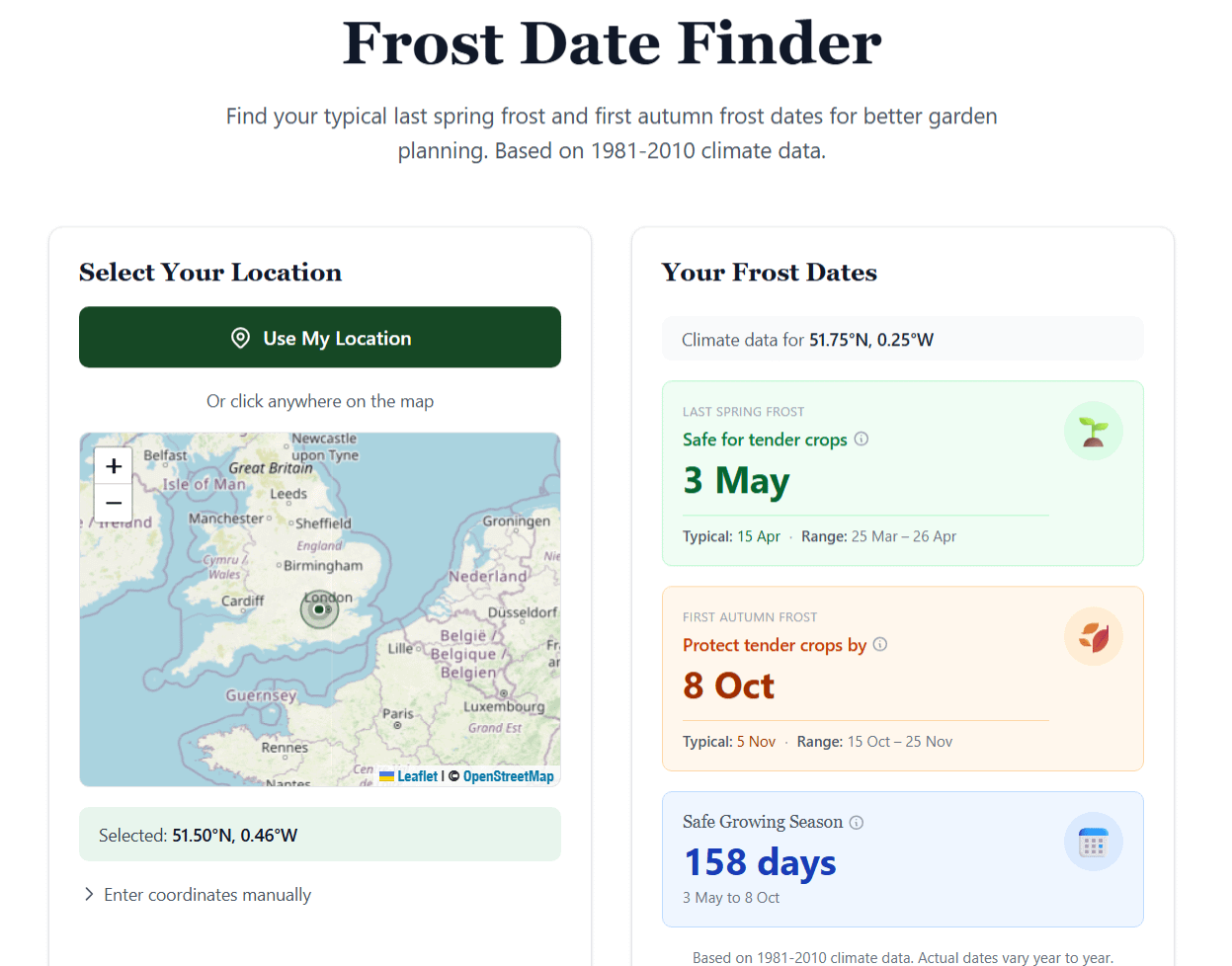
Ich habe mit Klimadaten herumgespielt und habe schließlich einen Frostdatenfinder entwickelt, der nützlich sein könnte, wenn Sie schnell die Frostdaten für Ihren Garten überprüfen möchten. Ich fand es überraschend schwierig, anständige Frostdaten für kleinere Städte oder für Länder außerhalb des üblichen Fokus auf Großbritannien und die USA zu bekommen, also wollte ich etwas, das für so ziemlich überall funktioniert.
Es nutzt den Copernicus ERA5-Datensatz als Quelle für das historische Wetter, ist völlig kostenlos, erfordert keine Anmeldung und sollte sowohl auf dem Desktop als auch auf Mobilgeräten schnell geladen werden.
Du kannst es hier ausprobieren:
https://leaftide.com/tools/frost-date-finder/
Ich habe dies zunächst für meine eigene Planung gemacht und dachte dann, dass es nützlich sein könnte, es mit anderen Gärtnern zu teilen. Wenn die Daten für Ihre Region falsch aussehen oder Sie möchten, dass etwas angezeigt wird, was derzeit nicht der Fall ist, freue ich mich sehr über Rückmeldungen und Korrekturen.
Mods: Ich hoffe, dass dies den Regeln entspricht. Bitte lassen Sie mich wissen, wenn dies nicht der Fall ist, und ich werde es entfernen.
Bearbeiten: Aufgrund des Feedbacks habe ich zwei Funktionen hinzugefügt:
- Überlagerungsoptionen auf der Karte (klicken Sie auf die Schaltfläche „Ebenen“ oben rechts auf der Karte)
- Wechseln Sie zwischen „Vorsichtig“ und „Typisch“ für die angezeigten Frostdaten
Wenn Sie noch weitere Vorschläge haben, können Sie diese gerne weiterleiten!
Von: jpbragatti
13 Comments
Thanks I checked it out for where i live (south eastern Australia) and it seems pretty much spot on for accuracy. Well done
Instant bookmark.
I have many seeds which are to be “sown 6 weeks before last frost”, but I’m never really sure when that is. This will help so much with planning next year.
You are great!
This is really great, although for my location the last frost date is about a week too early. The first frost is pretty much right on though.
Great website!
Clicking around a bit and looking at the values, would it be possible to have a button to overlay the source data grid? It might help some people who are close to the borders of the 0.25 degree grid to compare between the nearest grid squares and adjust their expectations a bit based on that. In some places it can be a week’s difference in the tender crops date, so it could help some people out!
If you’re ever interested in developing the project further, there’s also this article which describes a microclimate assessment based on the ERA5 data: [https://besjournals.onlinelibrary.wiley.com/doi/full/10.1111/2041-210X.13877](https://besjournals.onlinelibrary.wiley.com/doi/full/10.1111/2041-210X.13877) .
And the guys from NichemapR have [made a website that allows you to look up this kind of data](http://bioforecasts.science.unimelb.edu.au/app_direct/soil/), but it’s very technical and doesn’t provide the kind of gardening-relevant information that you do.
This is fantastic. Seriously. Thank you.
cool! thanks!
90% + a week is so cautious that it becomes useless in colder climates. The data looks right but a 35 day growing season is a bit short to plan for. National weather service gives me 126 days at 50%, 50% with your two(?) buffer weeks would be closer and still pretty safe.
This is a thing of beauty, and you are a god among gardeners.
Holy crap this is amazing, been looking for something that works outside the US/UK forever and most sites want you to pay for this info lol.
Wow, this is amazing, thanks! I’m in central Portugal but I’ve always struggled with recommendations for zone 10a because I always feel like the advice is off in terms of timing.
There are *wild* swings in dates in New Jersey, so many and so significant that I think there must be a glitch somewhere. 168 safe growing days in Berkeley Heights vs. 128 safe growing days in Flemington, which are less than an hour apart, and Flemington is further south. I know things get weird around the Great Swamp, but a 40 day difference is extremely unreasonable.
Down in Princeton I’m seeing 150 safe growing days, but in Cape May there are only 170 safe days? It’s two zones warmer than Berkeley Heights! 199 safe growing days in super far north Harrington Park? Something is not correct here.
So cool