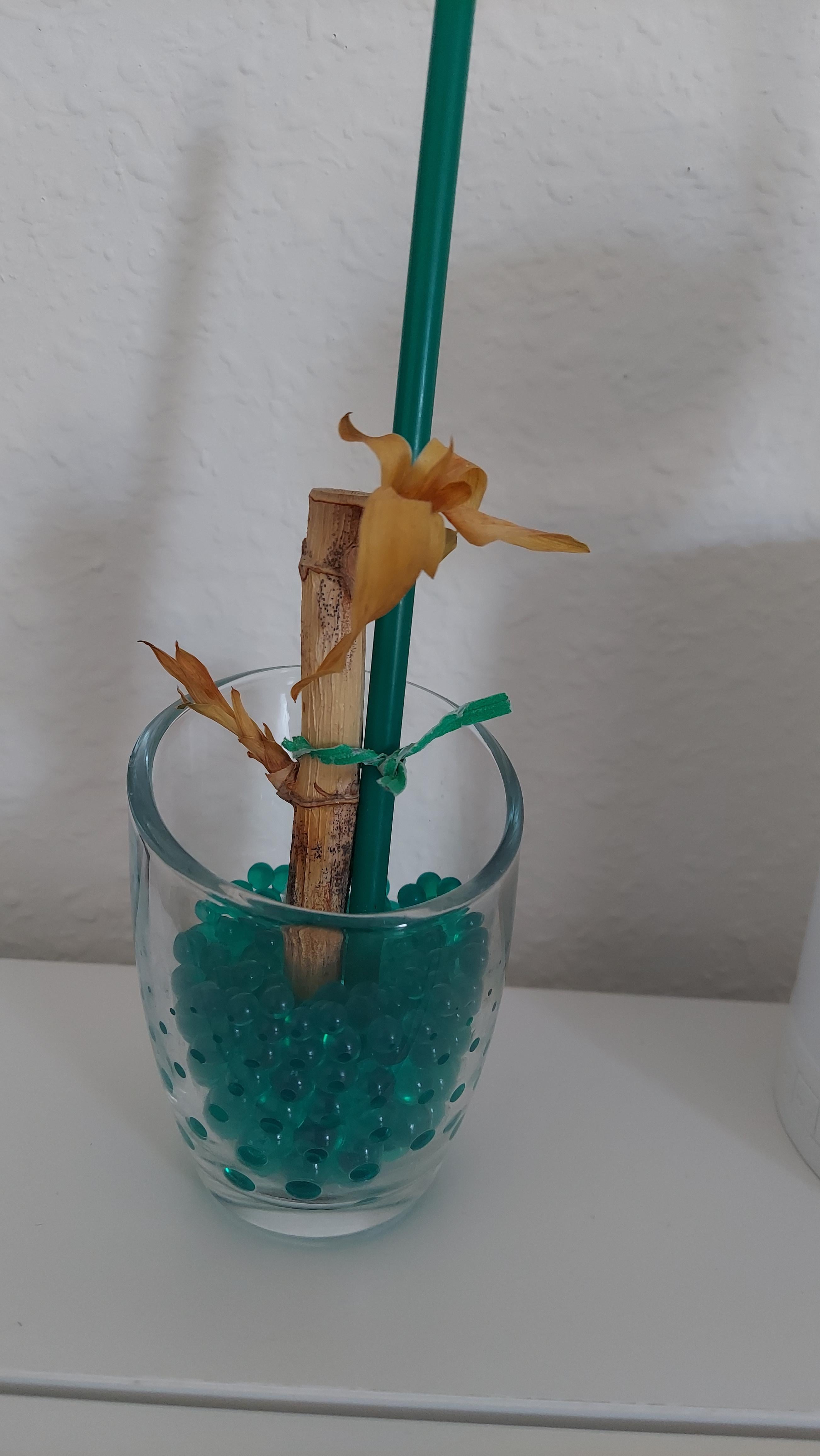
For extra information, I have had this plant for a year and kept it in gel-like water beads. I would water it once a week and keep it in indirect sunlight. It recently has been cold here so I’m not sure if that’s what caused it to yellow and dry up. I also spotted a bit of fuzzy mold in one spot 🙁
Impossible-Dark-669 on
Sorry, there’s no coming back. You see mold that goes in the trash or compost.
OriginalIll4567 on
From my experience when it looks like that it can’t really be saved…. From the colour of the leaves and the mold it looks like it got overwatered
pittqueen on
Genuinely curious why it was kept in gel beads instead of soil?
Jsjbb14535 on
She gone. Sorry for you loss
MaleHooker on
I’m not sure if this is meant to be a joke or not.
murderinthedark on
Is this a joke? This died ages ago. I’ve got dead bamboo in my backyard that look more alive than this.
I have done a bunch of recent research on raising my lucky bamboo correctly.
They can be planted in soil. That’s not my preference so I’m not going to comment on that.
I have raised my thriving five groups of lucky bamboo (purchased on Amazon) in small decorator pots in pebbles continuously immersed in water to the top of the pots. I learned that I have to change the water every week.
I began noticing some slight browning of the leaves and yellow spots on the leaves.
Thanks to the guidance of many redditers, I learned several things that I was doing wrong and that prompted me to do a deep research dive .
I had made the mistake of having them in direct sunlight. My research taught me that they have to be an indirect bright sunlight.
Second, I learned that they should not be allowed to go dry if they’re in pebbles and water….
Third, the type and quality of water is vital. I learned that both chlorine and fluoride can be toxic and injurious to Lucky Bamboo. So this pushed me to do my long postponed project of testing my tap water.
WARNING: If you buy test kits on Amazon, read the reviews carefully. Several of them don’t work. After two bad tries, I found a great test kit that includes bacterial testing
My testing showed heavy chlorine, heavy fluoride and other contaminants including very hard water.
I was actually injuring my lucky bamboo with tap water so at first I switched to using a Brita filter on my faucet. It removed both the chlorine and some other substances, but none of the fluoride.
The same problem existed using sodium thiosulfate which is used in aquariums to remove chlorine, The chlorine is neutralized but every other bad thing is still in the water.
Finally, I went all in completed something on my bucket list for ages… Being in my seventh decade and surviving multiple cancers, heart failure, covid etc. I have been really keen on changing to a very healthy diet, but I’ve been drinking lousy water … On my list was the item to get a purified water system, so my lucky bamboo issue pushed me over the edge…
I bought a very well reviewed countertop reverse osmosis water purifier system. Thank God I researched water purification because R/0 units remove not only the bad stuff but all of the minerals which are nutrients for plants (and humans). So I purchased remineralization products to add to each pitcher of water, and the test strips and my plants spurt of healthy green growth tell me that I’ve made the right decisions.
Hope this helps, ….while I not an expert, I am thorough at research and trial and error, and my indoor windowsill garden in my micro studio apartment (220 sqft) with 27 plants is filled with beauty, and the faint murmurings of plants singing: “Yippee ki-yay Water-Daddy”.

9 Comments
For extra information, I have had this plant for a year and kept it in gel-like water beads. I would water it once a week and keep it in indirect sunlight. It recently has been cold here so I’m not sure if that’s what caused it to yellow and dry up. I also spotted a bit of fuzzy mold in one spot 🙁
Sorry, there’s no coming back. You see mold that goes in the trash or compost.
From my experience when it looks like that it can’t really be saved…. From the colour of the leaves and the mold it looks like it got overwatered
Genuinely curious why it was kept in gel beads instead of soil?
She gone. Sorry for you loss
I’m not sure if this is meant to be a joke or not.
Is this a joke? This died ages ago. I’ve got dead bamboo in my backyard that look more alive than this.
—___—
1) Sander’s dracaena isn’t bamboo, despite being nicknamed lucky bamboo.
2) It’s dead, Jim.
I have done a bunch of recent research on raising my lucky bamboo correctly.
They can be planted in soil. That’s not my preference so I’m not going to comment on that.
I have raised my thriving five groups of lucky bamboo (purchased on Amazon) in small decorator pots in pebbles continuously immersed in water to the top of the pots. I learned that I have to change the water every week.
I began noticing some slight browning of the leaves and yellow spots on the leaves.
Thanks to the guidance of many redditers, I learned several things that I was doing wrong and that prompted me to do a deep research dive .
I had made the mistake of having them in direct sunlight. My research taught me that they have to be an indirect bright sunlight.
Second, I learned that they should not be allowed to go dry if they’re in pebbles and water….
Third, the type and quality of water is vital. I learned that both chlorine and fluoride can be toxic and injurious to Lucky Bamboo. So this pushed me to do my long postponed project of testing my tap water.
WARNING: If you buy test kits on Amazon, read the reviews carefully. Several of them don’t work. After two bad tries, I found a great test kit that includes bacterial testing
https://www.amazon.com/your-orders/pop?ref=ppx_yo2ov_mob_b_pop&orderId=113-0892644-6761021&lineItemId=jijgorkmtptspsps&shipmentId=B425TVvPy&packageId=1&asin=B0CDD82YLV
My testing showed heavy chlorine, heavy fluoride and other contaminants including very hard water.
I was actually injuring my lucky bamboo with tap water so at first I switched to using a Brita filter on my faucet. It removed both the chlorine and some other substances, but none of the fluoride.
The same problem existed using sodium thiosulfate which is used in aquariums to remove chlorine, The chlorine is neutralized but every other bad thing is still in the water.
Finally, I went all in completed something on my bucket list for ages… Being in my seventh decade and surviving multiple cancers, heart failure, covid etc. I have been really keen on changing to a very healthy diet, but I’ve been drinking lousy water … On my list was the item to get a purified water system, so my lucky bamboo issue pushed me over the edge…
I bought a very well reviewed countertop reverse osmosis water purifier system. Thank God I researched water purification because R/0 units remove not only the bad stuff but all of the minerals which are nutrients for plants (and humans). So I purchased remineralization products to add to each pitcher of water, and the test strips and my plants spurt of healthy green growth tell me that I’ve made the right decisions.
Hope this helps, ….while I not an expert, I am thorough at research and trial and error, and my indoor windowsill garden in my micro studio apartment (220 sqft) with 27 plants is filled with beauty, and the faint murmurings of plants singing: “Yippee ki-yay Water-Daddy”.